
How much do hummingbirds weigh? How fast can they fly—and can they really see red? These tiny birds have remarkable abilities, from hovering in midair to making long migration journeys. Explore fascinating hummingbird facts, learn which species you might see in your area, and discover what they eat and how to welcome them to your garden.
Hummingbird Size: How Much Do They Weigh?
These diminutive birds usually weigh between 2.5 and 6.5 grams—about 0.1 to 0.2 ounces—at maturity. For comparison, a U.S. penny weighs 2.5 grams. The egg of a hummingbird weighs just 0.4 to 2.4 grams. Hatchlings are even smaller—for example, a newly hatched ruby-throated hummingbird tips the scales at about six-tenths of a gram. However, when it’s time to migrate, hummers pack on the grams for the long trip—sometimes doubling their weight.
They are among the smallest birds, too, with most species measuring 2.5 to 5 inches long. The smallest bird, the bee hummingbird, is only 2 inches long—and weighs less than 2 grams.
How Fast Do Hummingbirds Beat Their Wings?
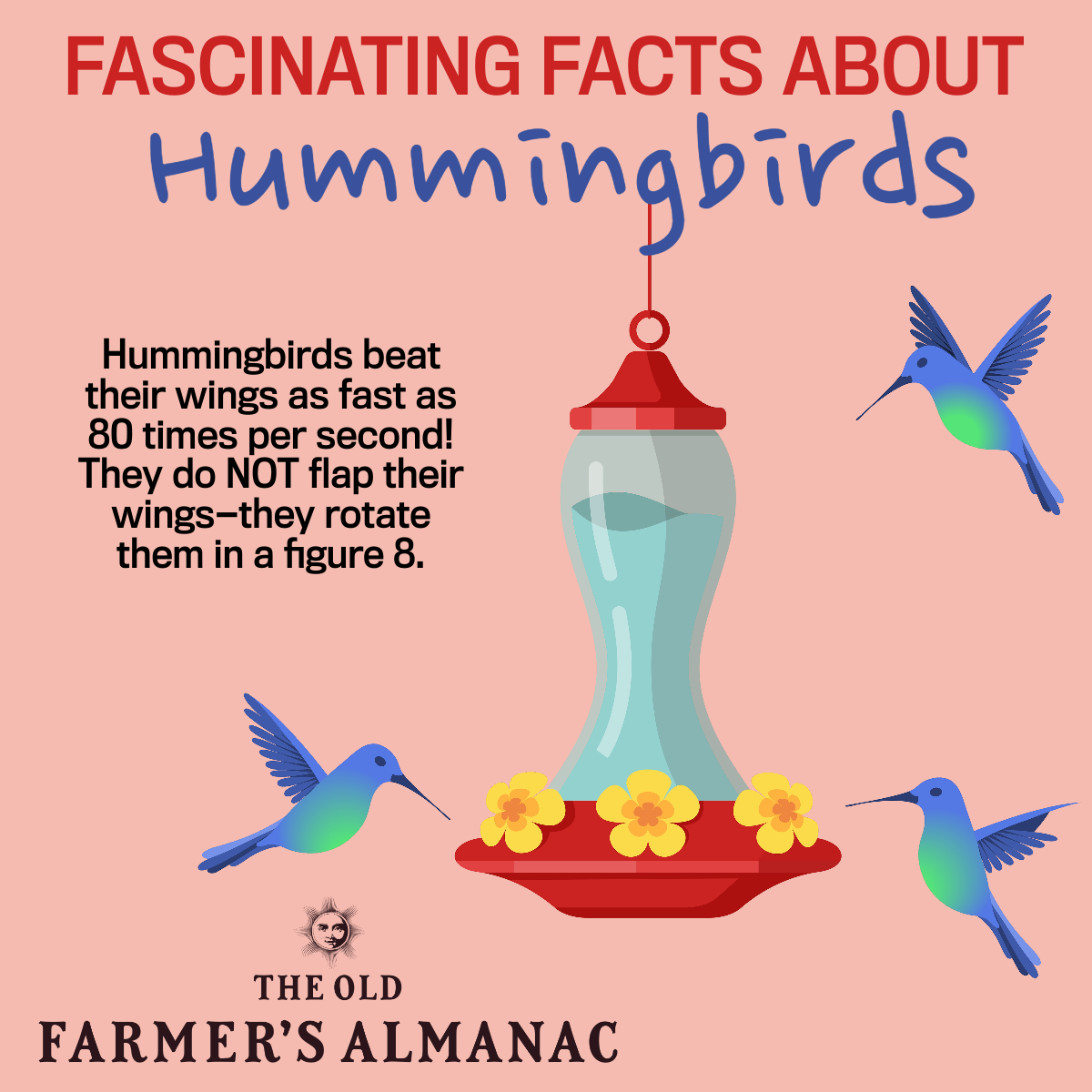
With their iridescent colors and relatively short wings, hummingbirds beat their wings as fast as 80 times per second! They don’t just flap their wings in the conventional way, though—while hovering, they may rotate them in a figure-eight pattern. In fact, their name comes from the fact that they move their wings so fast that they make a humming noise. Hummingbirds can hover, stop instantly, and fly in different directions (even upside down) with exquisite control.
Where Do Hummingbirds Live?
In the spring, 21 species fly thousands of miles northward from Mexico, Costa Rica, and other southern places to visit the United States and Canada. In the fall, they return to their southern homes.
The greatest number and variety of hummingbirds in North America can be found in western areas of the United States and as far north as Alaska. Only the Ruby-throated Hummingbird is found east of the Mississippi. The birds also visit southern Canada.
How Far Do Hummingbirds Migrate?
Many of these birds make round-trip migration flights of more than 994 miles (1,600 kilometers)! Although hummingbirds usually weigh less than an ounce, these tiny birds have a lot of energy. Hummingbirds have been measured at above 30 miles per hour in forward flight and just above 60 miles per hour during a courtship dive.

Credit: Matt Cuda/Getty
Some fly nonstop across the Gulf of Mexico (aka Gulf of America) in spring and autumn. Cornell University scientists report that they double their body weight by consuming nectar and insects in preparation for such flights. They burn all additional weight when crossing the Gulf of Mexico. During flight, their oxygen consumption per gram of muscle tissue—an indicator of aerobic energy use—is about 10 times higher than that of elite human athletes
When hummingbirds arrive in the north, they are sometimes confronted with unusually cold weather and survive by entering torpor—a low-metabolism, low-body-temperature state that conserves energy.
How Fast Is a Hummingbird’s Heart Rate?
Hummingbirds have a very high metabolic rate, with a heart rate of up to 1,260 beats per minute and breaths of up to 250 times per minute.
The long flights and wing-beating can make a hummingbird weary. Long flights require lots of energy, and hummingbirds frequently look for places to rest and refuel on trees and shrubs. Particular plants include birch trees and butterfly bushes. Don’t worry if you do not have these plants in your yard—a hummingbird might also rest on your feeder’s hanger.
Common Hummingbirds Types
Among the most common hummingbirds are the Ruby-throated, Rufous, and Anna’s Hummingbirds.
Ruby-throated Hummingbird
Typically only the Ruby-throated Hummingbird visits areas east of the Mississippi. The males have a distinctive ruby-red throat. The female has a white throat, and both male and female are greenish on the back and crown, with lighter undersides.
This hummer is found in summer across much of the eastern U.S. and southern Canada, in deciduous forests, meadows, and various other habitats. While some ruby throats cross the Gulf of Mexico during migration seasons, others take the long way around to wintering grounds and back. Males generally migrate a week or more ahead of females.

Rufous Hummingbird
A popular hummingbird in the western U.States, it makes the longest migration—sometimes into Alaska—for a bird so small. They have been extensively studied for foraging behavior and pollen transfer. Named for its distinctive coloration, males often have a solid rufous (reddish) back, though some have green back feathers. Adult females are bright green above and white below, with washed rufous sides.

Anna’s Hummingbird
This hummingbird is a year-round resident in parts of Pacific Coast and Southwest states, as well as British Columbia. The male is identified by its red throat and crown. The female has a small red patch on its throat. In their courtship displays, males ascend as high as 130 feet into the air and then swoop toward the ground with a curious burst of noise that they produce through their tail feathers.

Do Hummingbirds See Red?
We have a bird feeder close to our deck; another one is hanging on my front porch. After we had noticed very little hummingbird activity, a friend suggested that we paint the feeder red. One weekend, we spray-painted the feeder red.
Like magic, the hummingbirds were back! This isn’t an actual science experiment, but it made us investigate further.
It turns out that hummingbirds have a dense concentration of cones in their retinas. These cones contain pigments and oil droplets in shades of yellow to red, which seem to act like filters. The filters appear to heighten color sensitivity to red and also yellow, while muting colors.

What Do Hummingbirds Eat?
Hummingbirds live on flower nectar and insects, supplemented by food from hummingbird feeders.
Hummingbird Feeder Recipe
- We make our own sugar water (1 part white sugar to 4 parts water) and usually have to fill the red backyard feeder twice a week.
- Mix the sugar and water in a pot and heat on the stovetop enough to dissolve the sugar and allow to cool before putting it into feeders.
The water itself does NOT need to be tinted. Hummingbirds have remarkable spatial memories and flutter before feeders before they are even hung in the spring.
Hummingbird Flowers
Hummers will zoom towards any nectar-rich flowers. They have a heightened sensitivity to brightly-hued red and yellow flowers, but they are also speedy learners and will find nectar wherever they can.
The hummingbird is a prolific pollinator of flowers. So, to attract hummingbirds to your garden, make sure to include lots of plants known to attract hummingbirds.
What is a hummingbird’s favorite flower? Try bee balm and foxglove, just to name two. See the Almanac article on Flowers That Attract Hummingbirds.

When Do Hummingbirds Mate?
Many North American hummingbirds mate from spring into summer, with variation in the timing depending on species and location.
These tiny flyers are especially vocal during territorial disputes.. Sounds vary from chittering to a noises caused by wing movement.
The female selects the nest site and builds a sometimes-thimble-sized nest in about a week. Common materials for nests are moss and lichen, plant down, spider silk, cotton fibers, feathers, and fur or hair.
Tiny eggs—usually laid two at a time—hatch in about 2–3 weeks, and the young fledge within another few weeks. Pairs are only together for a few days or weeks. After mating, the male is on his own, leaving the female to incubate the eggs and feed the young mostly a diet of tiny insects.

Credit: PictureLake/Getty
What’s a Hummingbird’s Life Span?
Hummingbirds generally live for several years in the wild. At least one wild hummingbird was documented as living 12 years. Females may outlive males by several years, possibly due to the males’ high energy needs to defend territories and the long spring and fall migrations.
Hummingbird Predators
Hummingbird predators include swift-flying raptors, such as kestrels; other birds, such as blue jays; and some insects, such as the praying mantis. Cats are a danger, and there are even reports of hummingbirds being caught by frogs and large fish.

More Like This


- « Previous
- 1
- 2
- …
- 10
- Next »

Comments